
October 15, 2026 ~ Shabbat NOAH. SIGAH-IRAQ.
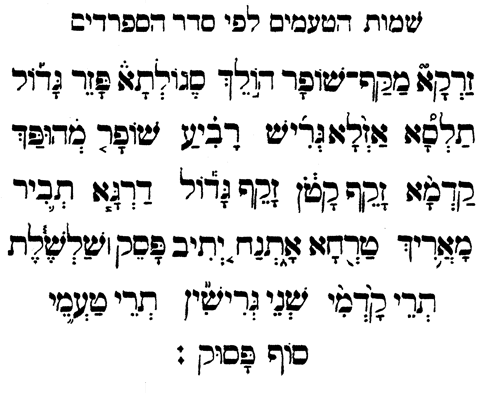
Introduction
“Ta’amei ha-miqra” or “te’amim”, known in English as “accents”, are signs written or printed in the Masoretic text of the Hebrew Bible (or Tanakh) above or below the words. They exist:
1. to mark the stressed syllable in each word (though a few signs always go on the first or last letter of a word);
2. as punctuation showing the word groups and breaks in a verse;
3. to denote the musical chant (“cantillation”) for the text.
The grammar of the te’amim
In general, each word in the Tanakh has one accent. This may be either a “disjunctive” (mafsiq), showing a division between that and the following word, or a “conjunctive” (meḥabber or mesharet), joining the two words (like a slur in music).
The disjunctives are traditionally divided into four levels, with lower level disjunctives marking less important breaks. For musical reasons, both conjunctives and lower level disjunctives may vary, depending on which higher level disjunctive follows them.
First level: sof pasuq (“end of verse”): marks the end of a verse & atnaḥ (“rest): marks the middle of a verse.
Second level: zaqef qaton: the usual second level disjunctive, zaqef gadol: replaces zaqef qaton when it constitutes a phrase on its own, tarḥa (“dragging”): precedes sof pasuq or atnaḥ, segolta (“bunch of grapes”): stronger second level disjunctive, used in very long verses, shalshelet (“chain”): replaces segolta when it constitutes a phrase on its own
Third level:
rebia’ (“fourth”): the
usual third level disjunctive,
zarqa (“throwing”):
precedes segolta,
qadma (“first”): precedes
zaqef qaton
Fourth level:
pazer gadol (“great
scattering”), talsha (“detached”),
gerish (“expulsion”): these
cluster, usually in that order,
near the beginning of a long half-verse,
shene gerishin: replaces
gerish when it is not preceded by
azla AND the word is stressed on
the last syllable
Conjunctives
One other symbol is tere ta’ame, double ma’arikh. There is some argument about whether this is another conjunctive or an occasional replacement for tebir.
The accents have the effect of
grouping the words of a verse into a number of characteristic phrases, each
with its own melody. Typical phrases are
ma’arikh tarḥa
ma’arikh sof pasuq;
ma’arikh
tarḥa
shofar holekh atnaḥ;
mehuppakh qadma shofar holekh zaqef
qaton; shofar holekh-paseq shofar
holekh rebia’; pazer gadol talsha
azla gerish. The same phrases can occur in shorter form, by omitting one
or more conjunctives.
Psalms, Proverbs and Job
The system of cantillation signs used throughout the Tanakh is replaced by a very different system for these three poetic books. These books are referred to as “sifre emet”, also being an acronym for the first letters of the three books (Iyov, Mishle, Tehillim).
The system for the poetic books uses many of the same symbols as the prose system, but often for entirely different purposes.
A verse may be divided into one, two or three stichs (half lines). A one-stich verse is divided by dehi, which looks like tarḥa but is under the last letter of the word. In a two-stich verse, the first stich ends with atnaḥ. In a three-stich verse, the first stich ends with ‘oleh ve-yored, which looks like mehuppakh (above the word) followed by tarḥa, on either the same word or two consecutive words, and the second stich ends with atnaḥ. The last stich ends with sof pasuq as in the prose books.
Major disjunctives within a stich are rebia’ qaton (immediately before ‘oleh ve-yored), rebia’ gadol (elsewhere) and tsinnor (which looks like zarqa). The last stich may be divided by rebia’ megurash, which looks like gerish combined with rebia’.
Minor disjunctives are pazer gadol, shalshelet gedolah, qadma legarmeh and mehuppakh legarmeh: all of these except pazer gadol are followed by paseq (vertical line). Mehuppakh without paseq sometimes occurs at the beginning of a stich.
All other accents are conjunctives.
The music of the te’amim
The accents guide the reader in applying a chant to Biblical readings. This chant is technically regarded as a ritualized form of speech intonation rather than as a musical exercise like the singing of metrical hymns: for this reason we always speak of “saying” or “reading” a passage rather than of “singing” it.
The melodies applied are widely different in different Jewish ethnic communities. Within each community, there are different chants for different books of the Bible.
The Syrian cantillation tradition is a member of the “Ottoman Sephardic” family: this family also includes the Turkish, Syrian, Egyptian and “Jerusalem Sephardic” traditions. The Karaite tradition, being based on the Egyptian, also forms part of this group, as does one form of the Iraqi tradition. (Another Iraqi melody is closer to the Moroccan and Spanish and Portuguese family.)
Separate melodies exist for the following books:
Any other book of Ketubim is read to the tune of Ruth.
History
Three systems of Hebrew punctuation (including vowels and accents) have been used: the Babylonian, the Palestinian and the Tiberian, only the last of which is used today.
Tiberian system
By the tenth century C.E., the chant in use in Palestine had clearly become more complex, both because of the existence of pazer gadol, gerish and talsha motifs in longer verses and because the realization of a phrase ending with a given type of break varied according to the number of words and syllables in the phrase. The Tiberian Masoretes therefore devised a comprehensive notation with a symbol on each word, to replace the fragmentary systems previously in use. In particular it was necessary to invent a range of different conjunctive accents to show how to introduce and elaborate the main motif in longer phrases. (For example, tebir is preceded by ma’arikh, a short flourish, in shorter phrases but by darga, a more elaborate run of notes, in longer phrases.) The system they devised is the one in use today, and is found in Biblical manuscripts such as the Aleppo Codex. A Masoretic treatise called Diqduqe ha-te’amim (precise rules of the accents) by Aaron ben Moses ben Asher survives, though both the names and the classification of the accents differ somewhat from those of the present day.
The Tiberian system spread quickly and was accepted in all communities by the 13th century. Each community re-interpreted its reading tradition so as to allocate one short musical motif to each symbol.
| Section | Pizmon | Page | Song | Commentary | Recordings | Application |
|---|---|---|---|---|---|---|
| Pentateuch | 4081 | P442 | סדר שמות הטעמים | Names of the Ta'amim. |
Jack Azar DMB M Kairey Ma'arekhet HaTa'amim: Moshe Dabbah Moshe Dwek Haim Daya- Nebiim Haim Daya- Torah Hamaoui- Esther Max E Tawil- Taamim of Torah- Introductory Lesson Max E Tawil- Taamim of Haftarah- Introductory Lesson D Binker-Duek Moshe Dwek Dr Isaac S Mordecai D Binker |
|
| 3001 | תורה | Maqam Sigah. The Torah is read every Monday, Thursday & Shabbat. |
 Salem Aisbeda, 1911- Exodus 12:21-25 D Tawil: Ta'amim for the Torah Salem Aisbeda, 1911- Exodus 12:21-25 D Tawil: Ta'amim for the Torah |
|||
| Haftarot | 4082 | P445 | הקדמה לקריאת הנביאים | Traditional verses recited prior to the reading of the Nebiim. |
G Shrem |
|
| 3003 | תהלים | Maqam Tehillim Maqam Rast for Egyptians, Maqam Nahwand for Syrians. Tehillim, or Psalms, are read during the prayer services. |
G Shrem Psalm 1 Recording Recording- Syrian Children Class Haim Asriqi/ Salem Aisbeda, 1911- Tehillim 1:1-3 |
|||
| Mishle | 3004 | משלי | Maqam Sigah (but different than Torah). Portions of this book are read during services. Some have a custom of reading this book during Shabuot. The passage "Eshet Hayil," read on Friday night Kiddush, is from this book. |
Y. Hamaoui G. Shrem G. Shrem Sample 2 M. Kairey chapter 1 Recording Max E Tawil- Mishlei 5 chapters Haim Asriqi, 1911- Mishle 1:1-3, Job 3:1-5 |
||
| Iyob | 3005 | איוב | Ancient undeveloped Rast. Chapter 1-3:1 (narrative) is read like Megillat Ruth. From 3:2 and onwards is read like Iyob. This book is read on Tisha B'Ab. |
G. Shrem G. Shrem M. Kairey chapter 1 M. Kairey chapter 3 Job 13- Max E Tawil Haim Daya- Sefer Eyob Job 20- Max E Tawil Job 19- Max E Tawil Job 18- Max E Tawil Job 17- Max E Tawil Job 16- Max E Tawil Job 15- Max E Tawil Job 14- Max E Tawil Job 12- Max E Tawil Job 11- Max E Tawil Job 10- Max E Tawil Job 09- Max E Tawil Job 08- Max E Tawil Job 07- Max E Tawil Job 06- Max E Tawil Job 05- Max E Tawil Job 01- Max E Tawil Job 02- Max E Tawil Job 03- Max E Tawil Job 04- Max E Tawil Recording Max E Tawil- Iyob- beginning chapters |
||
| Song of Songs | 3006 | SS1 | שיר השירים | Maqam Bayat. Read every Friday night. |
G. Shrem Recording Recording Max E Tawil- Shir Hashirim H Baruch Ben Haim Felix Tourgeman- Chapter 8 Salem Aisbeda, 1911- Shir Hashirim 1:1-8 H Zaki Sardar - Full Moshe Dwek D Tawil: Shir Hashirim |
|
| Ruth | 3007 | R1 | מגילת רות | Maqam Hoseni.This book is read on Shabuot. Aleppo Codex- Ruth 1 Aleppo Codex- Ruth 2 Aleppo Codex- Ruth 3 Aleppo Codex- Ruth 4 |
G. Shrem Haim Daya- Ruth 1 Recording Max E Tawil- Ruth- Ch 1 Max E Tawil- Ruth- Ch 2 Max E Tawil- Ruth- Ch 3 Max E Tawil- Ruth- Ch 4 Haim Asriqi/ Salem Aisbeda, 1911- Ruth 1:1-3, Qohelet 1:1-5 Mickey Kairey- Ruth Chap 1 |
|
| Lamentations | 3008 | L1 | מגילת איכה | Maqam Ajam. Read on Tisha B'Ab. |
G. Shrem G. Shrem M. Kairey Haim Daya Recording Max E Tawil- Full Haim Asriqi, 1911- Ekha 1:1-4 A Zafrani: Haazinu on Tisha B'ab |
|
| Esther | 3009 | מגילת אסתר | Maqam Saba-Mouhayar. Read on Purim. |
G. Shrem Rabia - from Syria |
||
| 3011 | שאר ספרי הכתובים | Iyob Chapter 1-2, Qohelet, Daniel, Ezra-Nehemia, and Dibrei Hayamim are read like Book of Ruth. |
Haim Daya- Sefer Daniel |
|||
| 3010 | משנה | Maqam Nawah. Some signs were also sometimes used in medieval manuscripts of the Mishnah, but apparently not today. |
G. Shrem G. Shrem Haim Daya- Mishnah Berakhot H Moshe Tawil- Mishnah Yoma |
